


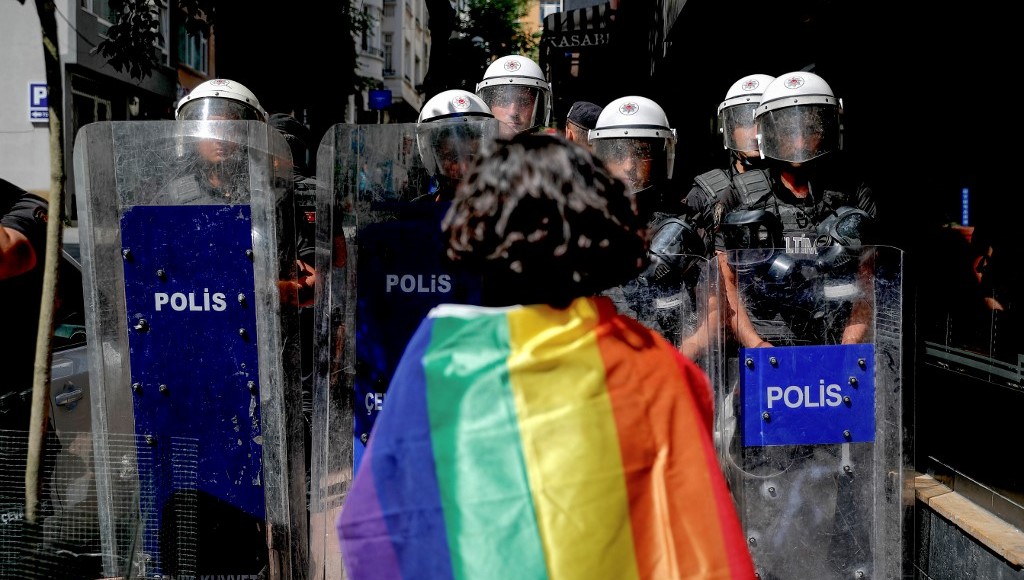
Turkey’s government is drafting a judicial reform bill that would impose prison sentences on people who publicly promote or depict gender identities or expressions deemed “contrary to biological sex,” or “against public morals,” the T24 independent news outlet reported.
The proposal, known as the 11th Judicial Package, would amend Article 225 of the Turkish Penal Code, which currently covers public indecency. Under the draft, anyone who “acts against their biological sex” or “encourages or praises such behavior” could face between one and three years in prison.
Another article would criminalize engagement or marriage ceremonies between same-sex couples, carrying sentences of up to four years. The maximum penalty for sexual acts performed in public would also increase from one year to three.
The legislation could also affect digital and broadcast media, including streaming platforms that feature same-sex relationships in films or series. Such content could be prosecuted for “encouraging behavior contrary to public morals,” according to the draft text.
In its justification the government said the measures aim to protect the “institution of the family” and ensure “the upbringing of physically and mentally healthy generations.” Officials have described the reforms as part of a broader effort to counter what they call “gender-neutrality movements” and to reinforce “moral and social values.”
The bill would also introduce new restrictions on gender reassignment procedures. The minimum age would rise from 18 to 25 and applicants would be required to be unmarried and obtain a medical board report from a health ministry–approved hospital confirming that the procedure is medically necessary for mental health reasons. The report could only be issued after four evaluations conducted at least three months apart.
Unauthorized gender reassignment surgeries would be punishable by three to seven years in prison, along with heavy fines for medical professionals who perform them outside the legal framework.
Turkey’s ruling Justice and Development Party (AKP) has increasingly portrayed LGBTQ+ visibility as a threat to public morality and family values. Pride marches have been banned in major cities for years, and officials frequently describe LGBTQ+ advocacy as an attack on traditional norms.
The proposed legislation has drawn strong criticism from rights advocates and public figures. LGBTQ+ journalist and politician İrfan Değirmenci, who publicly came out on social media last year, condemned the bill on X, saying: “What are you going to do, set up concentration camps? We will resist this regulation, which violates fundamental human rights and freedoms, until the end. No one’s existence can be a reason for imprisonment. Your repeated rhetoric fuels hate crimes. Enough!”
Ne yapacaksınız? Toplama kampı mı kuracaksınız?
Temel insan hak ve özgürlüklerine aykırı bu düzenlemenize sonuna kadar direneceğiz.
Hiç kimsenin varoluşu, hapis sebebi olamaz.
Isıtıp ısıtıp tartıştırdığınız niyetleriniz, nefret suçlarını teşvik ediyor.
YETER! https://t.co/QcPgfJoQoi— irfan değirmenci (@degirmencirfan) October 15, 2025
Human rights lawyer Eren Keskin also denounced the proposal, writing on X: “A hate crime is being organized, not through words, but through written law. And this is happening despite international conventions Turkey has signed. This is exactly what a patriarchal and militarized state mentality looks like.”
Activist and writer Yıldız Tar, the editor-in-chief of KaosGL.org, the news outlet of one of the country’s oldest LGBTQ+ rights organizations, warned that the law’s effects would reach far beyond the LGBTQ+ community.
Bu bir zorbalık tasarısı. Zorbalığa boyun eğmenin, sessiz kalmanın, cevaz vermenin bedeli sadece biz LGBTİ+'ların hapse atılması değil. Yatar, çıkarız. Ama çıktığımız memleket, geri kalan herkesin de köleleştirildiği bir yer olur. Karar bizim, hepimizin. pic.twitter.com/B2MBkDlXuE
— yıldız tar (@yildiz_tar) October 15, 2025
“This is a bullying bill,” they wrote on X. “The cost of bowing to bullying, staying silent or consenting is not only that we LGBTI+ people go to prison, we may serve time and get out. But the country we return to will be one where everyone else is also enslaved. The decision is ours, for all of us.”
If enacted, the 11th Judicial Package would represent one of the most restrictive legal measures targeting LGBTQ+ individuals in Turkey in recent decades.
Homosexuality is not illegal in Turkey, but homophobia is widespread. It is common for Turkish President Recep Tayyip Erdoğan and other politicians from his party to attack LGBTQ+ individuals and accuse them of perversion and ruining family values.
Meanwhile, Turkey was ranked 47th among 49 countries as regards the human rights of LGBTQ+ people in the 2025 edition of the Rainbow Index released in May by the International Lesbian, Gay, Bisexual, Trans and Intersex Association (ILGA), which placed Turkey among the bottom five countries for LGBTQ+ rights in Europe.
Turkish Minute with reporting from the Stockholm Center for Freedom