


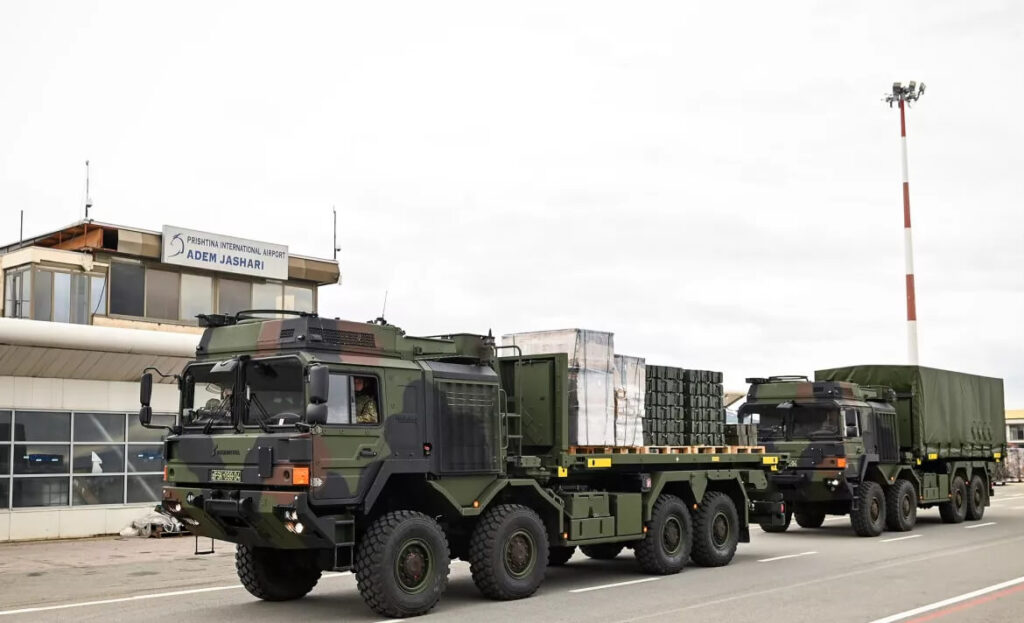
Kosovo has taken delivery of Turkish-made kamikaze drones, prompting sharp criticism from Serbian President Aleksandar Vucic, who accused Ankara of destabilizing the Balkans, according to media reports.
Kosovar Prime Minister Albin Kurti said Wednesday that the shipment of Skydagger drones from Turkish defense contractor Baykar arrived months ahead of schedule, the state-run Anadolu news agency reported. He personally welcomed the containers in Pristina and said dozens of Kosovo Security Force personnel have already been trained to operate the systems.
“The contract was signed last December with Baykar. The drones were scheduled to arrive in January 2026, but we got them three months early,” Kurti wrote on Facebook, describing the weapons as ready-to-fly, first-person-view drones equipped with explosives to strike moving and stationary targets. He did not specify the number delivered, though officials said “thousands” had arrived.
Serbian President Vucic denounced the move as “a violation of the UN Charter and Resolution 1244,” which ended NATO’s 1999 intervention and formalized Serbia’s withdrawal from Kosovo.
“It is now completely clear that Türkiye does not want stability in the Western Balkans and is once again dreaming of restoring the Ottoman Empire,” Vucic wrote on X, adding that Serbia understands “their real intentions.”
I am appalled by Türkiye's behaviour and the brutal violation of the UN Charter and UN Security Council Resolution 1244, as well as the continued arming of the authorities in Pristina. It is now completely clear that Türkiye does not want stability in the Western Balkans and is…
— Александар Вучић (@predsednikrs) October 8, 2025
Kosovar President Vjosa Osmani defended the purchase, accusing Vucic of hypocrisy. “He shamelessly attacks a NATO member state that helps us defend peace, while deepening defense cooperation with Russia, China and Iran,” she wrote on X.
On the same day that President Trump praised Türkiye and President Erdoğan for their outstanding leadership in promoting global peace and security, Vucic is shamelessly attacking Türkiye, a country who, as a NATO member state, is helping us defend peace.
I am proud to have…
— Vjosa Osmani (@VjosaOsmaniPRKS) October 8, 2025
Tensions between Pristina and Belgrade, which still regards Kosovo as its territory, have escalated in recent weeks. Vucic warned that “everyone is preparing for war,” accusing Kosovo of trying to build Western support before conflict breaks out. Osmani dismissed the comments as a threat to regional stability.
The latest exchange comes ahead of Kosovo’s local elections scheduled for Sunday in the Serb-majority north, where the Belgrade-backed Serb List party is expected to dominate after boycotting the last vote. Vucic has pledged more financial support to ethnic Serbs in the region, a move Pristina sees as interference, according to Bloomberg.
Kosovo declared independence from Serbia in 2008, a move Belgrade rejects as illegal. Under UN Security Council Resolution 1244, adopted in 1999, Kosovo was placed under interim UN administration and NATO’s KFOR mission was authorized to provide security.
While Kosovo now governs itself, KFOR remains the only internationally recognized military force in the territory, and Resolution 1244 continues to be invoked by countries that do not recognize Kosovo’s statehood.
Western mediators have urged both sides to avoid escalation and return to EU-facilitated talks. NATO’s KFOR mission, with about 5,000 troops, continues to patrol Kosovo and maintain security.