


Ömer Murat*
The Trump era marks a decisive break in US foreign policy. Unlike the Obama and Biden administrations, Trump does not view international organizations such as NATO or the alliances they underpin as normative commitments. Instead, he pursues a foreign policy that is openly “transactional” — short-term, interest-driven and pragmatic. This policy is not anchored in shared values, ideology or durable strategic partnerships, but rather in a simple quid pro quo: I’ll give you this; you give me that.
This shift has significant consequences for Turkish–US relations and for President Recep Tayyip Erdoğan, who has come under fire for his increasing authoritarianism. As Trump might put it, ‘If improvements in Turkey’s governance don’t line my pockets or advance immediate American interests, then why bother?’
For Erdoğan, who has effectively undermined the rule of law in Turkey, Washington’s new stance is a welcome reprieve, particularly as he consolidates his grip on power while his popularity wanes.
Erdoğan’s rocky history with the West helps to explain this relief. His ties with the West deteriorated when he violently crushed the anti-government Gezi Park protests in the summer of 2013 and dismantled judicial independence to block corruption investigations into his inner circle, which became public late that year. The Obama and Biden administrations viewed democratic governance as integral to long-term American interests, framing the rivalry with China as a contest between democracies and autocracies in their rhetoric. As Erdoğan tightened his grip Washington cooled relations, and Erdoğan was not invited to the White House during Joe Biden’s term in office.
The Halkbank case, a long-running US federal prosecution against Turkey’s state-owned Halkbank and several businessmen who are accused of helping Iran evade US sanctions, continues to cast a shadow over Erdoğan and his inner circle, involving shadowy dealings with Iranian-Turkish businessman Reza Zarrab, who became a key witness for the US authorities after his arrest in 2016. Halkbank, Turkey’s second-largest state-bank, has been under investigation for sanctions evasion for nearly a decade, and closing the case is at the top of Erdoğan’s wish list for Washington, yet this remains unfulfilled.
Meanwhile, Turkey’s dependence on the West for its military and economy means that smooth relations with Washington are indispensable. Erdoğan’s failure to achieve this has come at a high cost, most notably with Turkey’s expulsion from the F-35 Joint Strike Fighter program.
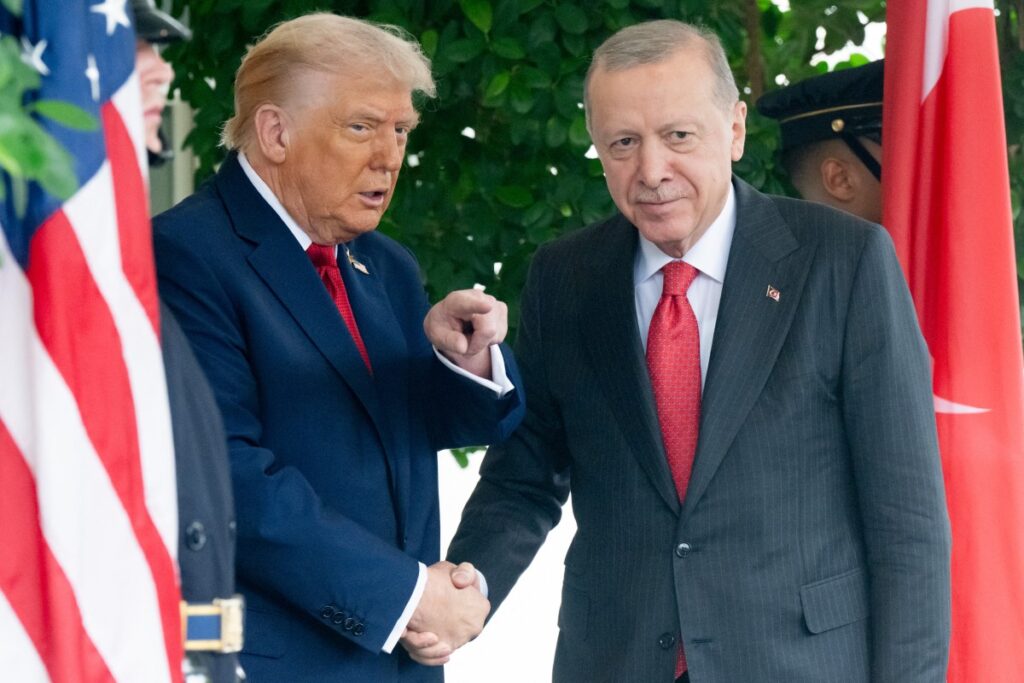
Enter Trump, who appears willing to offer Erdoğan the legitimacy he craves in exchange for concessions. On the eve of Erdoğan’s recent visit to the White House, the US Ambassador to Turkey Tom Barrack candidly outlined this deal, signaling that Washington would turn a blind eye to Erdoğan’s authoritarianism and potential corruption, including his involvement in the Halkbank case, if Turkey were to purchase American products, such as Boeing aircraft, F-16 jets and liquefied natural gas (LNG). The US also seeks Erdogan’s support on regional issues that are critical to American interests.
That bargain suits Erdoğan’s immediate, personal objectives. Under its cover he can intensify domestic crackdowns — sidelining rivals through legal pressure and placing government trustees in opposition-run municipalities — while still receiving red-carpet treatment in Washington.
However, in this asymmetrical power dynamic, where the United States holds overwhelming military and economic leverage, Erdoğan risks conceding more than he gains for Turkey’s broader interests.
Transactional diplomacy is a double-edged sword that seldom favors the weaker party. The United States is far stronger militarily and economically, so opening negotiations from such an imbalanced position leaves Ankara with little leverage. This was made clear at the joint press conference, when President Trump bluntly demanded that Turkey stop buying Russian oil, even though replacing a large proportion of Turkey’s oil imports would be costly and difficult. During the same visit Turkey committed to purchasing $43 billion worth of US-sourced LNG over 20 years, a far more expensive option than Russian natural gas. Such commitments could not only cause economic hardship for Turkey, but also damage Erdoğan’s carefully cultivated relationship with Russian President Vladimir Putin.
Erdoğan’s demeanor during the visit revealed his deference to Trump. He avoided contentious topics such as Syria, complied with Trump’s request to make a positive statement on reopening the Heybeliada Seminary and refrained from forcefully addressing the situation in Gaza, despite it supposedly forming a key part of his rhetoric. Trump’s offhand remark that he “[doesn’t] know where Erdoğan stands on the Gaza issue” highlights how even pressing regional crises take a back seat to deal-making.
In the short term, Trump’s willingness to overlook democratic backsliding benefits Erdoğan personally. He can eliminate rivals, seize opposition-held municipalities and still receive red-carpet treatment in Washington. However, this does not translate into gains for Turkey. On the contrary Erdoğan will find himself yielding more and more to American demands in return for symbolic legitimacy.
While Trump’s approach may yield short-term gains for the US, it could cause long-term damage to America’s global reputation. Trump’s praise of Erdoğan and his crude joke about election fraud — “He knows rigged elections better than anybody” — could offend Turkey’s democratic opposition and those who view America as a defender of democratic values. As Erdoğan becomes more authoritarian, the legitimacy that Washington bestows on him will highlight US hypocrisy, leading to Trump making greater demands in this uneasy relationship.
Turkey’s deepening authoritarianism is also eroding its economy. Without the rule of law, corruption spreads unchecked, domestic capital flees abroad and foreign investors hesitate. The comparison to Argentina’s chronic crises — the “Argentinization” of Turkey — is becoming harder to ignore. One day, the Trump administration may be held accountable by global markets for enabling this decline.
Erdoğan did not rise to power with Washington’s blessing, nor can he sustain his rule through it. Trump’s transactional approach lacks the ideological or strategic depth of past US–Turkish relations, offering only fleeting support. As Erdoğan’s popularity wanes, his reliance on Trump will not prevent Turkey from sliding towards a post-Erdoğan era characterized by increasing unrest and economic strain. In a relationship devoid of ideological anchors or strategic depth, such borrowed legitimacy offers no cure for the regime’s terminal illness.
A leader standing on shifting ground cannot be steadied by grasping at a foreign branch. That branch will snap — and when it does, Washington’s short-term maneuvers will look less like astute diplomacy and more like complicity in Turkey’s long-term unraveling.
* Ömer Murat is a political analyst and a former Turkish diplomat who currently lives in Germany.
Disclaimer: The views expressed in this opinion piece are those of the author and do not necessarily reflect the editorial stance of Turkish Minute.