


Yasemin Aydın*
The developments of recent months in Turkey — the arrest of İstanbul Mayor Ekrem İmamoğlu of the main opposition Republican People’s Party (CHP), the suspension of more than 15 opposition mayors and the violent imposition of a state-appointed trustee on the İstanbul headquarters of the CHP — mark more than a political crisis. They expose a deeper fault line: the erosion of society’s capacity to assert itself as a political collective.
İmamoğlu is not just any politician. He is President Recep Tayyip Erdoğan’s strongest rival for the presidency and consistently leads him in the polls. His 2019 victory in İstanbul, wresting control of the city from Erdoğan’s ruling party, was seen as a turning point in Turkish politics. His party is the country’s largest opposition force and the only one capable of posing a nationwide challenge to the ruling bloc. That İmamoğlu and his party have now been targeted is therefore not merely a tactical maneuver, but a structural attempt to eliminate political competition itself. At the same time this move has a history: The practice of the appointment of trustees has been systematically used for nearly a decade to depose elected mayors of the pro-Kurdish party and replace them with state-appointed officials. What was tested there is now being deployed against the party that represents nearly half of the electorate.
As German historian and philosopher Hannah Arendt emphasized, political freedom is realized in collective action, when people come together to constitute a shared world rather than merely endure authority. It is precisely this potential that is now under attack, hollowed out step by step. For students and younger generations, who stand at the heart of anti-government protests, this loss is felt most acutely. Their participation is not only an expression of outrage over economic decline or mismanagement but above all is a sign of deep anxiety about the future. Protest thus becomes a practice of reclaiming time: an insistence that the future is still negotiable.
The government, however, interprets the protests from an entirely different angle. For them, they are nothing more than an opposition ploy to distract from alleged corruption. This interpretation mirrors what James C. Scott, one of the world’s most widely read social scientists, describes as the “public transcript” of domination: a narrative in which power seeks to render resistance unreadable, stripping it of moral meaning and reducing citizens to mere pawns in elite power struggles. Yet the aim is not only to brand the opposition as “alien to the state.” The pattern follows a far more dangerous logic that recurs in authoritarian contexts: dehumanization. Opponents are no longer treated as fellow citizens engaged in political debate; they are constructed as enemies of the state, stripped of legitimacy and reduced to obstacles to be eliminated. As sociologist Zygmunt Bauman argued, dehumanization turns political opponents into administrative problems, objects to be managed rather than subjects with rights.
This logic continues what has been institutionalized since 2016: civil society, journalists and the faith-based Gülen movement, blamed by the government for a failed coup in 2016, an accusation it denies, have been systematically defined as existential threats. The same repertoire — criminalization, appointment of trustees, mass arrests — is now being deployed against the CHP. From an anthropological perspective, this reveals what German philosopher Erich Fromm described as the authoritarian character’s need for enemies: Power sustains itself by continually producing figures that embody danger, disorder and “non-Turkishness.”
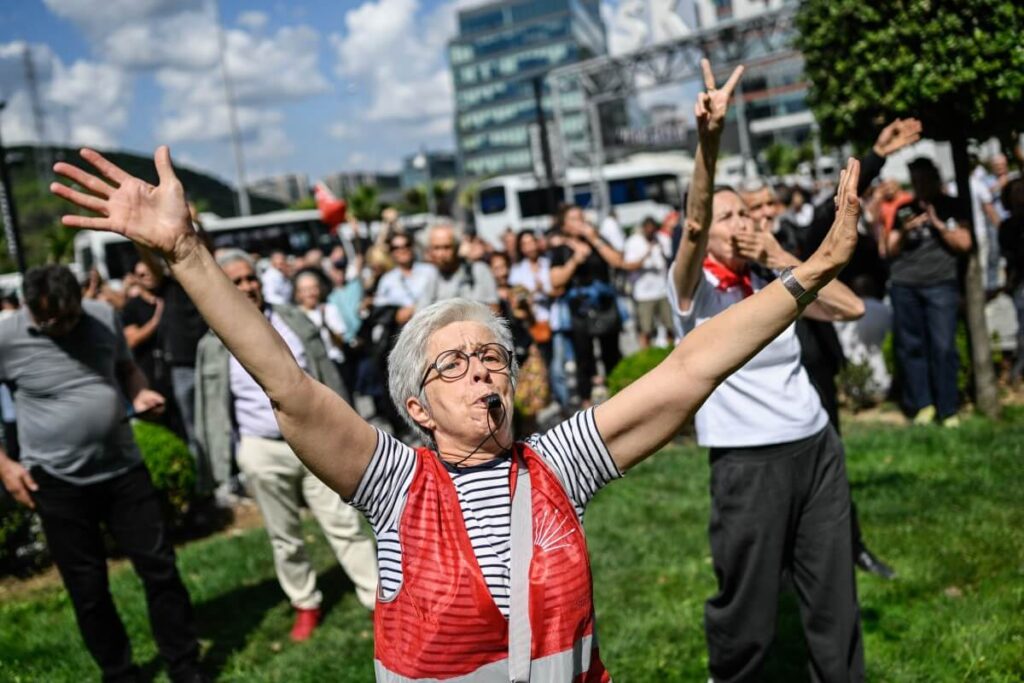
And yet, authoritarian attempts to fragment and discipline dissent often have the unintended effect of reinforcing solidarity from below. Sit-ins, vigils and the symbolic defense of party buildings despite police violence are not merely tactical responses. They are forms of political ritualization. They fulfill a function similar to what Maurice Halbwachs described in relation to collective memory: practices through which groups affirm belonging, narrate shared vulnerability and reconstruct agency under conditions of exclusion.
The real stakes therefore extend far beyond the organizational survival of the CHP. What is under attack is Turkish society’s capacity to constitute itself as a political collective. The outcome of this struggle will determine whether the country continues to slide toward a “Republic of Trustees,” where institutions are stripped of their democratic substance and citizens are reduced to objects of control, or whether the shared experience of repression will generate new forms of collective empowerment. Hope dies last, but given the CHP’s entrenched habits, it is difficult to sustain hope.
For the international community, one point must be clear: Developments in Turkey cannot be reduced to the success or failure of a single party. The issue at stake is whether citizens can preserve the ability to imagine and assert themselves as a political community. In this sense Turkey today faces not merely a national crisis, it stands as a test case for how societies in the 21st century confront authoritarian assaults on collective agency, through alienation as well as dehumanization.
*Yasemin Aydın is a social anthropologist and social psychologist in Germany.
Disclaimer: The views expressed in this opinion piece are those of the author and do not necessarily reflect the editorial stance of Turkish Minute.