


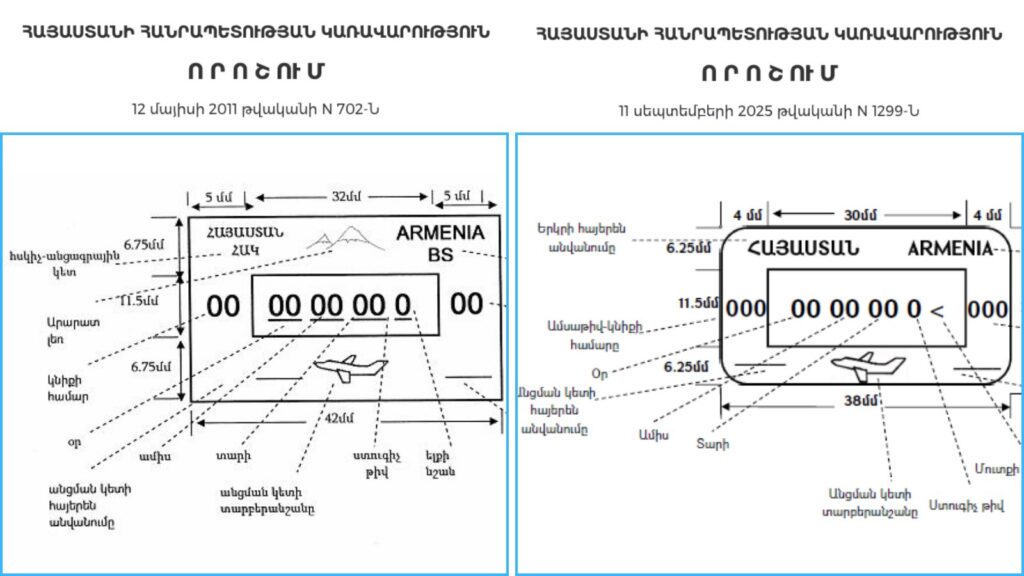
Armenia will drop Mount Ararat from passport stamps at its border crossings, a government decree showed, in a move officials say aims to avoid sending “dangerous messages” to neighbors but which critics denounce as a concession to Ankara.
The order, signed by Prime Minister Nikol Pashinyan on September 11 and reported by the Asbarez website, takes effect on November 1 and introduces redesigned stamps without the mountain’s silhouette
Pashinyan defended the change at a security conference in Yerevan, arguing symbols should not provoke conflict. “You built your house within the confines of your neighborhood, but you paint a picture on your house, especially on the outer walls, that symbolizes your perception that your neighbor does not deserve to have what he has,” he said.
Ruling party secretary Artur Hovhannisyan said passport stamps should feature only state emblems and not send “dangerous messages.”
Opposition leader Seyran Ohanyan countered that the government was acting “under coercion” to satisfy the Ankara.
Mount Ararat, known in Turkey as Mount Ağrı, lies across the border but has long been central to Armenian identity. It is featured on the coat of arms, currency and cultural works, with Armenians living around the mountain until the early 20th century. Some nationalist groups still claim it “belongs” to them. In recent years, Pashinyan’s government has promoted Mount Aragats — Armenia’s highest peak inside its borders — as the centerpiece of national symbolism.
The decree came as Armenia and Turkey push a fragile normalization process launched in late 2021. The two sides have agreed on some concrete steps, including opening the land border for third-country nationals and resuming direct air cargo, while also discussing possible rail links and visa facilitation. The border remains officially closed, and Ankara continues to tie broader progress to a peace deal with Azerbaijan, though both governments stress that the dialogue is continuing “without preconditions.”
Officials in Ankara have described recent contacts as constructive, with Turkish media pointing out the decision on stamps as a gesture aligned with normalization.
Pashinyan and Turkish President Recep Tayyip Erdoğan have met several times, most recently in İstanbul in June 2025. A day after the decree, envoys Serdar Kılıç and Ruben Rubinyan met in Yerevan, with Kılıç crossing the Alican checkpoint by land for the first time in decades, underscoring how symbolic and diplomatic steps are moving in parallel.
The new stamps, set for November 1, will carry only technical border-crossing details. Analysts say the change reflects the government’s “Real Armenia” approach, downplaying sentimental symbols in favor of pragmatic representation. Whether the move paves the way for fully reopened borders and restored diplomatic ties remains to be seen.