


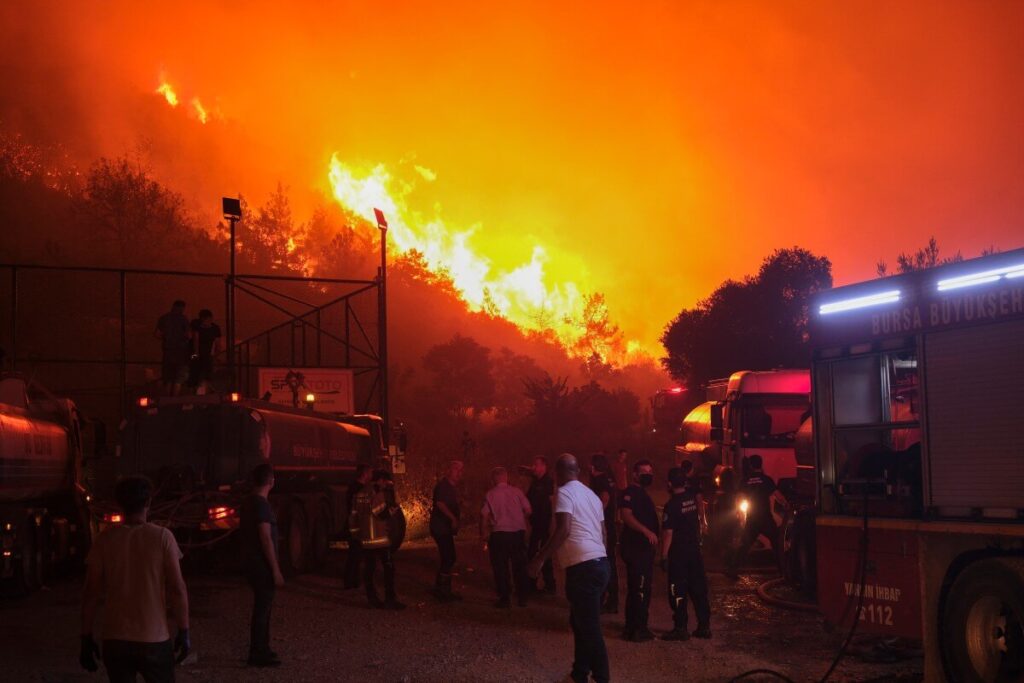
The wildfires that raged across Greece, Turkey and Cyprus this summer were 22 percent more intense and 10 times more likely than they would have been in a world without climate change, Bloomberg reported, citing scientists.
The extremely hot, dry and windy conditions that drove the chaotic spread of fires across the eastern Mediterranean would only occur once every century without man-made climate change, according to researchers from World Weather Attribution, a group of scientists that conducts fast studies using peer reviewed methods to determine the influence of climate change on extreme events. The 1.3C degree of warming the world has experienced since pre-industrial times means such events can now happen once every 20 years.
“We’re looking at a bleak picture for southern Europe’s forests,” said Bikem Ekberzade, a researcher at the Eurasia Institute of Earth Sciences in İstanbul. “With climate change allowing the meteorological conditions to become more conductive to burn, we’ll see larger, more severe and more frequent wildfires.”
Europe has suffered its worst year on record for wildfires, with over a million hectares burnt across the region. The continent is warming faster than any other, and the Mediterranean is a hotspot for climate change, with heat waves, drought and strong winds making the fires more frequent and intense. At least 20 people died across Turkey, Cyprus and Greece and over 80,000 were evacuated due to the fires in June and July.
“We have fires happening in places that we didn’t expect,” said Apostolos Voulgarakis, the AXA chair in wildfires and climate at the Technical University of Crete. In Greece “this is the third consecutive summer with a catastrophic fire season that’s in many ways unprecedented.”
To quantify the effect of climate change on the wildfires, scientists analyzed weather data and climate models to compare how the events would have unfolded on a planet without warming. This is the first ever rapid attribution study on a wildfire in Europe, and researchers drew from their experience with a previous study focusing on blazes in Canada in 2023.
For their calculations, scientists used a Canadian-made metric that measures how difficult it is to extinguish a fire once it has started, and another that focuses on fire risk by looking at the impact that hot and dry air have on vegetation. They also analyzed the rainfall trends during the winter preceding the fire season.
Governments in the region are used to fires and they learnt from past disasters, but the challenges this year have been overwhelming, said Maja Vahlberg, a technical advisor at the Red Cross Red Crescent Climate Centre. “Even with hundreds of pre-deployed firefighters, reinforcements from neighboring countries, and water-dropping planes, the blazes have been devastating.”
In Turkey, a severe wildfire in June, much earlier than usual, caught authorities, researchers and forecasters by surprise, Ekberzade said. The fact that most fires were started by people makes them much harder to predict, she said. In contrast, Greece has improved its ability to detect fires and extinguish them before they become too large, Voulgarakis said. But it could do more on prevention.
“These are, areas where we’re not well-prepared,” he said. “Because it takes time, and because it takes more strong political will.”
Wildfires are a frequent and troubling occurrence during Turkey’s summer months as the weather becomes hotter and drier. Each year the government faces criticism for its inadequate response and lack of preparedness.
The soaring temperatures this summer intensified wildfires that swept across southern and western provinces. Driven by drought and strong winds, the fires destroyed homes, forced evacuations and overwhelmed firefighting efforts.
The death toll was at least 17, with many more injured or displaced. Emergency services struggled to contain the blazes as temperatures soared and dry vegetation turned vast areas into tinderboxes.
One of the worst cases was also the summer of 2021, when 137 fires raged across 30 provinces. President Recep Tayyip Erdoğan and his government faced accusations of mismanagement and lack of preparation after admitting the country has no serviceable firefighting planes.
This year’s historic heat in Turkey pushed the mercury beyond the 50-degree mark for the first time this summer.
A reading of 50.5 degrees Celsius (122.9 Fahrenheit) was recorded on July 25 in Silopi, a town in the southeastern province of Şırnak, marking the highest temperature in the country’s history.
It surpassed the previous national record of 50.0 degrees Celsius set in Hassa, Hatay, in southern Turkey in August 2023. The extreme heat was part of the unprecedented Mediterranean heat wave that shattered hundreds of local temperature records across Turkey and the broader region. Silopi is located about 30 kilometers (18 miles) from the Iraqi border.