


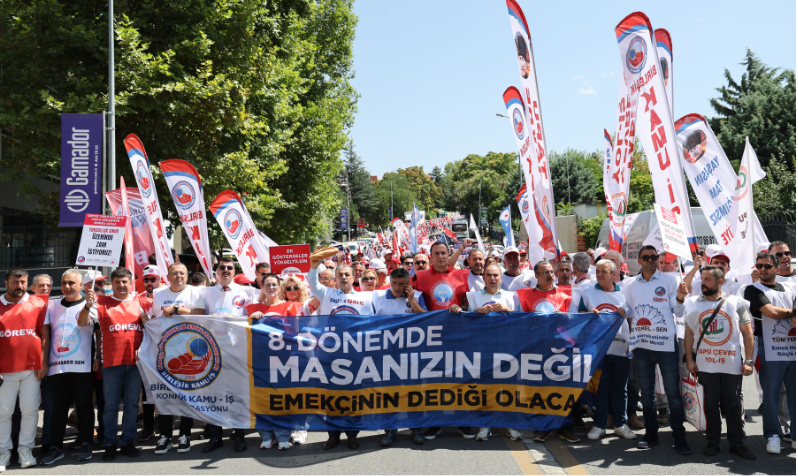
Police in Ankara blocked a march by the United Public Workers Confederation (Birleşik Kamu-İş) to the presidential palace on Friday after civil servant wage talks ended in deadlock, with the dispute moved to the Public Servants Arbitration Board for a binding decision.
Officers cordoned off the confederation’s headquarters in Kızılay before the planned 2 p.m. start and told organizers they could speak only in front of the building.
Union members began a one-hour sit-in after police blocked their march.
Confederation Chair Orhan Yıldırım said they had sought a meeting with President Recep Tayyip Erdoğan and added, “We did not elect officials to leave us hungry.”
The deadlock in the eighth-term collective bargaining talks sends the dispute between the government and the Civil Servants Trade Union (Memur-Sen) to the 11-member arbitration board, whose ruling will be final and carry the force of a collective agreement.
The negotiations, which had begun on August 1, covered about 6.5 million civil servants and retirees.
Labor Minister Vedat Işıkhan’s third and final offer was an 11 percent raise for the first half of 2026 and 7 percent for the second half, followed by 4 percent in each half of 2027, plus a 1,000-lira increase in base pay.
Memur-Sen rejected the offer.
Public sector unions staged walkouts and rallies this week.
The Confederation of Public Sector Trade Unions (KESK) led a march to the Labor and Social Security Ministry in Ankara and said an arbitration referral only “ties the hands of workers” because the board’s composition is set by the government.
KESK was joined by Birleşik Kamu-İş and other groups including BASK, DMK, HAK-SEN, YURT-SEN and ASİM-SEN. Memur-Sen and the Turkish Public Workers Labor Union (Kamu-Sen) held separate protests.
Memur-Sen also denounced reported disciplinary probes against members who joined a nationwide strike on Monday and cited Constitutional Court rulings that protect union actions as part of the right to organize.
Memur-Sen demands an 88 percent raise for 2026 and 46 percent for 2027, including six-monthly increases of 25 and 20 percent in 2026 and 20 and 15 percent in 2027. It also seeks a 10,000-lira rise in base salaries plus a 10 percent prosperity share at the start of 2026, a 7,500-lira rise at the start of 2027, a monthly 2,925-lira collective agreement bonus and 17,600 lira in housing support.
A prosperity share is an additional payment meant to offset losses in purchasing power and improve living standards.
The wage dispute unfolds against high inflation and rising living costs. The Turkish Statistical Institute reported annual inflation of 33.52 percent in July.
The independent Inflation Research Group estimated 68.68 percent.
The Confederation of Turkish Labor Unions said the July hunger threshold for a family of four was 26,413 lira, above the monthly minimum wage of 22,104 lira, and set the poverty line at 86,036 lira.
A main opposition Republican People’s Party (CHP) deputy chair, Ankara lawmaker Gamze Taşcıer, joined Birleşik Kamu-İş at its headquarters during Friday’s sit-in.