


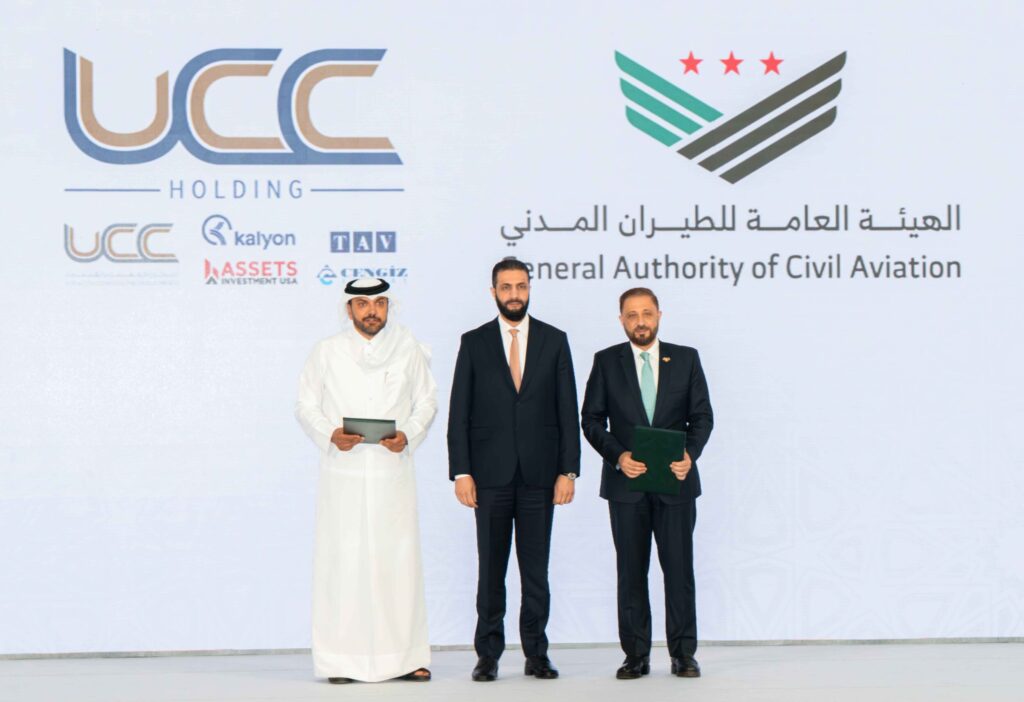
A Qatar-led consortium that includes Turkish construction contractors Kalyon Holding and Cengiz Holding along with TAV Airports has signed a $4 billion memorandum of understanding with the Syrian Civil Aviation Authority to redevelop and expand Damascus International Airport, Qatar’s UCC Holding announced on Thursday.
The signing ceremony took place in Damascus on Wednesday, with Syrian President Ahmed al-Sharaa presiding. US Ambassador to Turkey and Special Envoy for Syria Tom Barrack was also in attendance.
Barrack praised the agreement on X as a major step toward post-conflict recovery and regional reintegration, following President Donald Trump’s decision to lift US sanctions on Syria.
“The future of a prosperous and peaceful Syria is in the hands of Syria and its regional partners, like Qatar’s UCC and Türkiye’s Cengiz and Kalyon groups,” he posted, referring to the companies awarded the build-operate-transfer (BOT) contract for the airport.
The airport redevelopment is part of a broader $14 billion investment package signed by Syria with foreign companies on the same day. According to Syria’s SANA state news agency and investment website Zawya, the package also includes a $2 billion metro project in Damascus with a UAE company, a $2 billion commercial tower development with Italy-based UBAKO and several additional real estate and infrastructure agreements.
Following the overthrow of longtime ruler Bashar al-Assad in December during a rebel offensive, Syria’s new authorities have sought to attract foreign investment to rebuild critical infrastructure after nearly 14 years of civil war.
The US and European Union have lifted sanctions on Syria in the wake of Assad’s ouster, opening the door to renewed trade and investment.
The airport redevelopment will be carried out under a BOT model in five phases, with the aim of transforming Damascus International Airport into a regional hub capable of handling 31 million passengers annually.
The first phase targets an increase in capacity to 6 million passengers in the first year, followed by expansions to 16 million and eventually to the full projected volume. The modernized facility will meet international standards and include up to 32 gates, advanced passenger boarding systems, upgraded air navigation services and a redesigned terminal featuring international retail and dining options.
The project also includes redevelopment of a 50-kilometer access road and a $250 million initiative to revitalize Syrian Airlines, which will involve the purchase of 10 new Airbus A320 aircraft.
The consortium behind the deal includes UCC Concessions Investments LLC of Qatar, Assets Investments USA LLC and Turkish contractors Cengiz Holding, Kalyon Construction and TAV Tepe Akfen.
Cengiz and Kalyon are part of a group of companies often referred to by Turkish opposition figures as the “gang of five” due to their close ties to President Recep Tayyip Erdoğan and dominance in public contracts.
Speaking after the signing, UCC Chairman Mohammad Moutaz Al-Khayyat described the project as “a strategic partnership to rebuild one of Syria’s most vital gateways to the world.”
Kalyon Holding Chairman Murathan Kalyoncu highlighted the group’s prior experience with Istanbul Airport, which was completed in 42 months and is now among the busiest in the world.
“We hope this marks a turning point for Syria and contributes to long-term regional stability,” he said.
In May, a similar consortium led by UCC Holding signed a $7 billion MoU for power generation projects in Syria. The agreement includes a 5,000-megawatt facility expected to produce 35 billion kilowatt-hours of electricity annually, enough to supply a major share of the country’s energy needs.
In July Syria also signed an $800 million agreement with DP World to develop and operate a multi-purpose terminal at the port of Tartous for 30 years under a BOT model. That deal includes plans for new industrial and free trade zones. Also in July Saudi Arabia pledged $6.4 billion in investments, including nearly $3 billion for real estate and infrastructure and over $1 billion for telecommunications and IT projects.
The recent surge in foreign-backed infrastructure deals follows a gradual warming of diplomatic ties between Damascus and several regional capitals, particularly in the Gulf.
However, human rights groups and Western analysts have warned that large-scale reconstruction projects without accompanying political reforms could entrench existing power structures and marginalize local communities.