


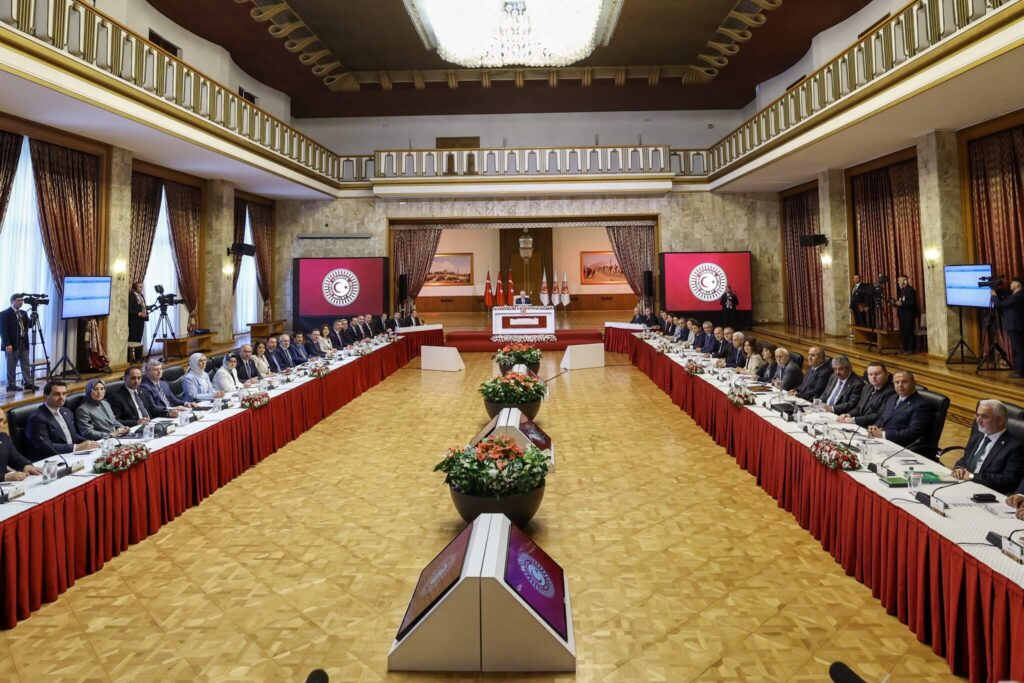
Turkey’s parliament on Tuesday hosted the inaugural meeting of a newly formed commission tasked with advancing efforts to end the outlawed Kurdistan Workers’ Party (PKK)’s armed campaign and promoting legal and political reconciliation with the country’s Kurds, according to the BBC Turkish service.
The 48-member commission, made up of lawmakers from 11 parties, convened in Ankara for the first time. The nationalist opposition İYİ (Good) Party declined to participate, leaving its three allocated seats vacant.
"Terörsüz Türkiye" süreci kapsamında Meclis’te kurulan komisyon, TBMM Başkanımız @NumanKurtulmus'un başkanlığında toplandı.
📎 https://t.co/45t4oEAKbN pic.twitter.com/soV9GKzl4t
— TBMM (@TBMMresmi) August 5, 2025
Thirty PKK militants burned their weapons in a ceremony in northern Iraq last month, marking a symbolic first step towards ending a decades-long conflict with Turkey in which more than 40,000 people have been killed.
In his opening remarks Parliament Speaker Numan Kurtulmuş outlined the commission’s guiding principles as “transparency, openness and pluralism” and described the initiative as a historic opportunity to overcome the trauma of conflict and reinforce national unity.
“This commission is not tasked with writing a new constitution or solving every problem at once,” he said. “Its mission is to demonstrate that this parliament is not only the voice of the people but also the carrier of social peace, the guarantor of brotherhood and the legitimate address for a lasting solution.”
Kurtulmuş stressed the importance of national ownership of the process and warned against provocative rhetoric that could derail the initiative.
“This is not the issue of any single party, group or identity. It is a matter of survival that concerns every citizen, whether Turk or Kurd,” he said.
He added that the process would extend beyond political actors and that broader segments of society would be included to help build public support. “Opinion leaders, universities, the legal community and civil society organizations will also contribute to the commission,” he said.
While the commission does not have formal legislative authority, its recommendations are expected to guide legal reforms to the Turkish Penal Code, the Counterterrorism Law and the Law on the Execution of Sentences.
The commission is expected to meet weekly over the summer and submit draft legislative proposals by the fall. Its second meeting is scheduled for Friday, when lawmakers will be briefed behind closed doors by officials from the National Intelligence Organization (MİT), the Interior Ministry and the Foreign Ministry.
Commission named amid naming dispute
Amid ongoing disputes over the commission’s title, the Parliament Speaker’s Office announced Tuesday that it will be officially named the “Commission for National Solidarity, Brotherhood and Democracy.” The name was approved during the opening session.
The final wording reflects suggestions from across the political spectrum, incorporating input from the far-right Nationalist Movement Party (MHP), an ally of President Recep Tayyip Erdoğan, as well as the main opposition Republican People’s Party (CHP) and the pro-Kurdish Peoples’ Equality and Democracy Party (DEM Party). Other proposed names included the “Commission for a Terrorism-Free Turkey,” “Brotherhood and Solidarity Commission” and the “Commission for a Livable Turkey.”
Opposition calls for real reform
Murat Emir, parliamentary group leader for the CHP, warned against a merely symbolic process and called for genuine political reform. He urged the commission to be “functional, not symbolic,” and to serve as “a bold voice for democracy and the Kurdish issue.”
The “Kurdish issue,” a commonly used term in Turkish political discourse, refers to the demand for equal rights and recognition by the country’s Kurdish population.
Meral Danış Beştaş of the DEM Party raised the continued imprisonment of former Peoples’ Democratic Party (HDP) co-chairs Selahattin Demirtaş and Figen Yüksekdağ, and criticized the government’s ongoing practice of appointing trustees in place of elected Kurdish officials.
She also called for recognition of the “right to hope” for Abdullah Öcalan, the imprisoned leader of the PKK, who has been held in a high-security prison on İmralı Island since 1999. The “right to hope” refers to the legal principle that certain prisoners may be eligible for conditional release after serving part of their sentence, based on good behavior.
The renewed peace process was initiated in October 2024 by Nationalist Movement Party (MHP) leader Devlet Bahçeli, a key government ally. Bahçeli publicly called on jailed PKK leader Öcalan to urge the militant group to lay down its arms. Öcalan responded in February with a message calling on the PKK to disarm and disband.
The PKK, designated a terrorist group by Turkey and its Western allies, began its insurgency in 1984. It decided in May to disband, disarm and end its armed campaign, saying it “has completed its historic mission” in line with Öcalan’s call.
The DEM Party facilitated the talks between Öcalan and Ankara during the process by regularly visiting Öcalan in prison.