

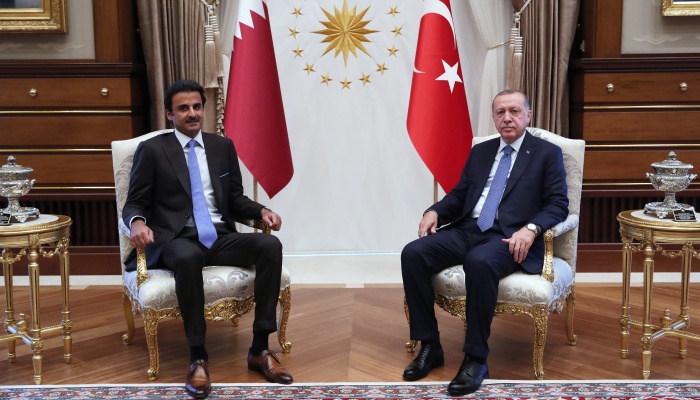
 between Turkey and Qatar entered into force today, marking a new chapter in economic cooperation between the two countries, according to a statement from the Turkish Ministry of Trade.)
A comprehensive Trade and Economic Partnership Agreement (TEOA) between Turkey and Qatar entered into force today, marking a new chapter in economic cooperation between the two countries, according to a statement from the Turkish Ministry of Trade.
Originally signed in 2018, the agreement is designed to eliminate tariffs, reduce non-tariff barriers and deepen bilateral trade. Turkish officials expect the pact to help increase trade volume to $5 billion in the medium term.
According to data from the Turkish Statistical Institute (TurkStat), trade volume between Turkey and Qatar was $1.1 billion in 2024, down from a record $2.2 billion in 2022. Despite the decline, Turkey maintained a trade surplus of $328 million last year. Officials attribute the drop to global economic headwinds, including post-pandemic supply chain disruptions and weakened international demand.
Scope of the agreement
The TEOA eliminates mutual duties on a significant share of goods and introduces measures to ease trade, including rules on technical standards, anti-dumping and frameworks for services and e-commerce.
According to the ministry, the agreement improves market access for Turkish exports in sectors such as automotive, construction materials, home appliances, textiles, footwear, machinery and jewelry. In agriculture, it facilitates the export of eggs, dairy, seafood, fresh produce, nuts and processed foods.
In return, Turkey will allow zero-tariff access to selected Qatari goods, including dates, flax, tobacco and pumice stone.
In the services sector, the agreement includes provisions for financial services and telecommunications and sets the stage for future collaboration in legal services, advertising, distribution, education, tourism and transportation.
Strategic and regional significance
Turkey’s trade network includes a customs union with the EU, free trade agreements with 23 countries and preferential trade deals with six others. The TEOA adds a key Gulf partner to this expanding network.
It also introduces modern e-commerce provisions, covering online consumer protection, digital data privacy and the promotion of paperless trade.
LNG and energy ties remain separate
While the TEOA does not include energy products such as liquefied natural gas (LNG), Qatar remains a strategic partner in Turkey’s broader energy diversification agenda. A 2015 memorandum of understanding between BOTAŞ, Turkey’s state-owned petroleum and natural gas pipeline corporation, and Qatar’s state-owned energy company, QatarEnergy, for long-term LNG supply did not yield large-scale shipments.
Data show Qatar’s LNG role in Turkey has declined. In the first half of 2021, Turkey imported no LNG from Qatar, relying instead on Algeria, the United States and Nigeria. As of 2023, LNG made up about 32 percent of Turkey’s natural gas consumption, with Qatar contributing minimally.
Though energy is not part of the new trade deal, analysts say stronger bilateral economic ties may lay the groundwork for future cooperation in the energy sector.