


Turkey secured what officials claimed was more than $9 billion in defense agreements during the 17th International Defence Industry Fair (IDEF 2025) held in Istanbul this month, with a record $5.85 billion attributed to exports, President Recep Tayyip Erdoğan announced following a cabinet meeting, according to the state-run Anadolu news agency.
The announcement underscores Ankara’s increasing reliance on the defense sector to drive high-value exports and bring in foreign currency as the country continues to grapple with macroeconomic pressures.
Global participation and new products
IDEF 2025 brought together 1,491 companies and 231 official delegations from 103 countries, attracting more than 120,000 visitors to the İstanbul Expo Center. According to Haluk Görgün, the head of Turkey’s Presidency of the Defense Industry (SSB), more than 1,100 new products were exhibited and 270 signing ceremonies were held, approximately 65 percent of which focused on exports.
Largest potential export: KAAN fighter jets to Indonesia
One of the fair’s most high-profile developments was a preliminary agreement with Indonesia for 48 KAAN fifth-generation stealth fighters, signed with Turkish Aerospace Industries (TAI). If finalized, it would represent Turkey’s largest-ever defense export.
However, the deal remains contingent on several unresolved factors. The KAAN jet is still under development and relies on US-made General Electric F110 engines for its early production batches. Re-exporting those engines to Indonesia would require US export licenses, a process that is not automatic and could be blocked for political or regulatory reasons.
Indonesia’s simultaneous participation in South Korea’s KF-21 fighter program and existing commitments to buy Rafale jets from France and F-15EX aircraft from the US have raised questions about Jakarta’s ability to fund multiple overlapping defense programs. Analysts suggest Indonesia may be using parallel deals to hedge its bets or gain leverage in negotiations.
Confirmed naval sale to Indonesia
Unlike the conditional KAAN deal, a firm agreement was signed for the sale of two Turkish-built MILGEM-class frigates to Indonesia, reportedly worth around $1 billion. The agreement marks a significant step in Turkey’s push to expand its naval exports into Southeast Asia.
Strategic partnerships and regional ventures
Other announcements at IDEF 2025 showcased Ankara’s emphasis on joint production and technology transfer. Drone manufacturer Baykar signed a strategic agreement with Korean Air to co-develop next-generation unmanned aerial systems.
In the land systems domain, Turkish vehicle maker Katmerciler and Malaysia’s Deftech reached a joint production deal for EREN 4×4 tactical vehicles, which will be built in Malaysia for export across the region.
TAI also signed a protocol with Azerbaijan’s MİRĀS to modernize and maintain Russian-origin aircraft, targeting shared regional customers in the post-Soviet sphere.
Hypersonic missiles and other new technologies
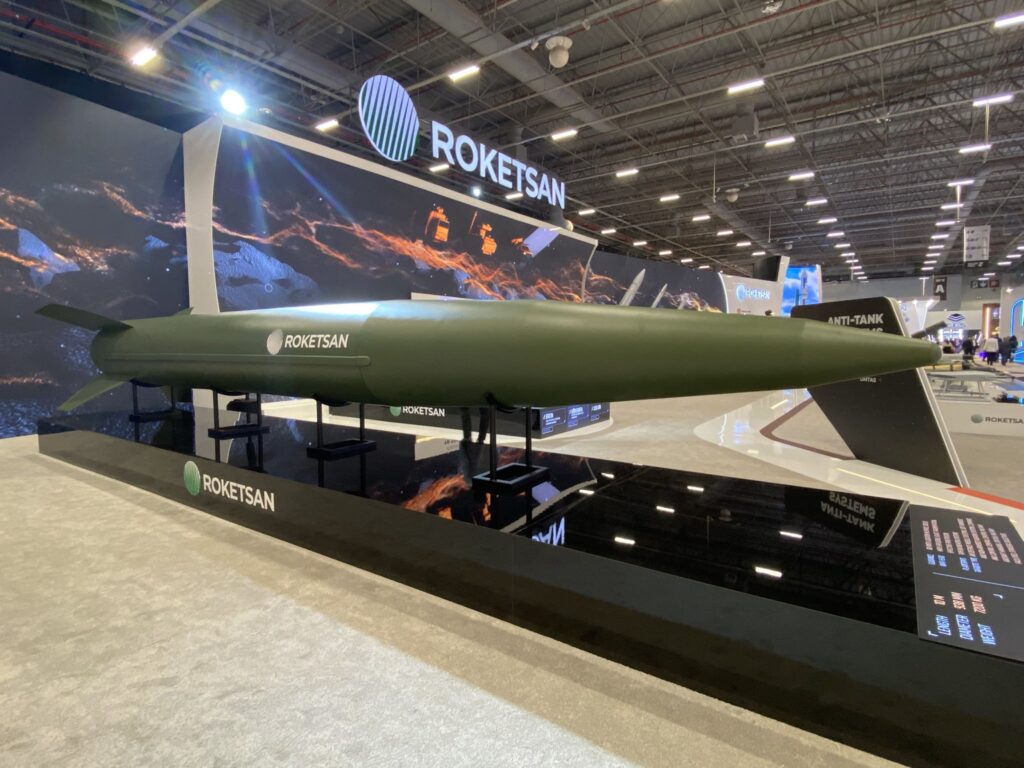
IDEF 2025 also served as a platform for unveiling key new defense technologies developed by Turkey’s domestic arms industry. Roketsan introduced the Tayfun Block 4, described as Turkey’s first hypersonic ballistic missile, capable of reaching speeds of Mach 5 and hitting targets at a range of up to 1,000 kilometers.
The NEB HAYALET, a new bunker-busting bomb designed to penetrate over seven meters of reinforced concrete and compatible with NATO-standard aircraft, was also displayed.
In the maritime sector, shipbuilder STM showcased a new Fast Attack Craft and a line of Unmanned Surface Vessels (USVs), including the MARLIN ASuW variant, the ULAQ Global, and the SANCAR. The rollout reflects Ankara’s growing ambitions in autonomous systems and naval warfare.
Dual-track global strategy
Analysts say the developments at IDEF reflect Turkey’s dual-track strategy: deepening NATO alignment while positioning itself as an alternative supplier for countries that face political, financial or regulatory obstacles when dealing with US, European, Chinese or Russian arms makers.
“The model of co-production and technology transfer is key to Turkey’s appeal,” said defense analyst Fatih Yurtsever. “For countries like Indonesia and Malaysia, it offers a path to build domestic industry capacity with fewer political constraints than Western suppliers impose.”
According to data from the Stockholm International Peace Research Institute (SIPRI), Turkey was ranked the world’s 11th largest arms exporter between 2020 and 2024, with defense exports increasing by 103 percent over that period. Turkey now meets more than 80 percent of its own defense needs domestically, up from just 20 percent in the early 2000s — a transformation largely driven by earlier Western arms embargoes.
Challenges ahead
Despite the optimistic announcements, experts caution that several obstacles remain. These include the potential for export control disputes, financial uncertainty among foreign partners and the internal economic strain of sustaining a rapidly expanding military-industrial complex.
Still, Turkey’s defense industry recorded a record $7.15 billion in exports in 2024. If key barriers — especially the US export license for KAAN engines — are overcome, IDEF 2025 could mark a turning point in Turkey’s emergence as a global defense exporter.