


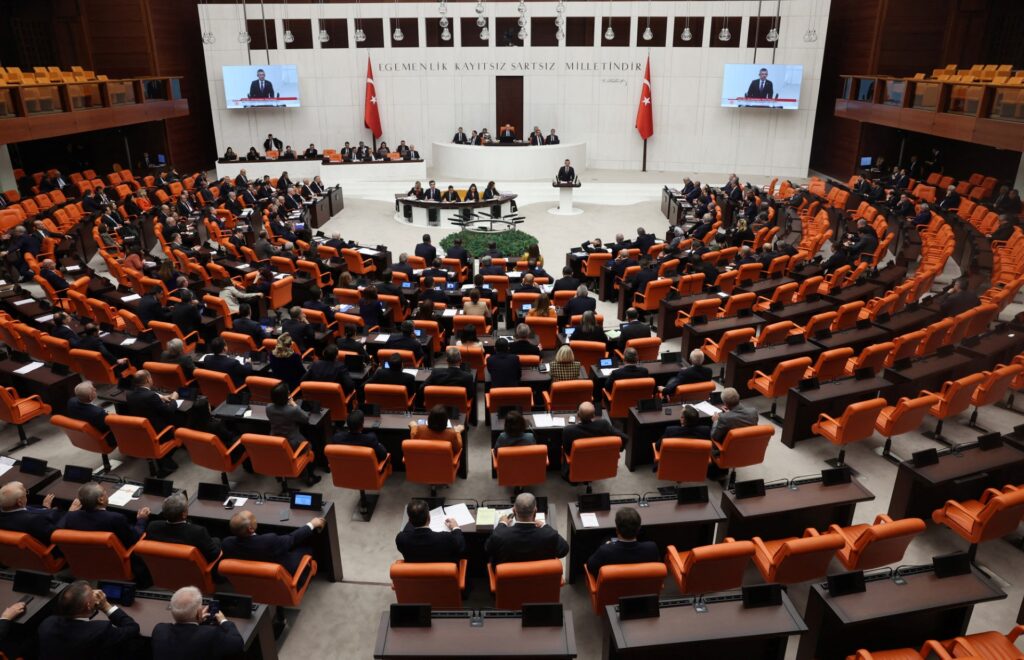
The speaker of Turkey’s parliament has formally asked political parties to submit delegate names for a 51-member parliamentary commission tasked with overseeing the next phase of a state-led process aimed at ending the Kurdistan Workers’ Party’s (PKK) armed campaign and transitioning toward legal and political reconciliation.
In letters sent this week Speaker of Parliament Numan Kurtulmuş invited parties to designate their members by July 31. The commission will include representatives from across the political spectrum.
The commission will be composed of 21 lawmakers from the ruling Justice and Development Party (AKP), 10 from the Republican People’s Party (CHP), four each from the pro-Kurdish Peoples’ Equality and Democracy Party (DEM Party) and the far-right Nationalist Movement Party (MHP), three each from the nationalist İYİ (Good) Party and the leftist Yeni Yol and one member each from smaller parties including HÜDA PAR, the Welfare Again Party, the Workers’ Party of Turkey (TİP), the Labor Party (EMEP), the Democratic Left Party (DSP) and the Democrat Party (DP).
The commission’s formation follows a critical peace gesture on July 11, when 30 PKK fighters symbolically burned their weapons in a public ceremony in Sulaymaniyah, northern Iraq. The move came in response to a February call by jailed PKK leader Abdullah Öcalan for the group to abandon armed conflict and seek a democratic path forward. The Turkish government has responded by coordinating backchannel talks and initiating the legal groundwork for broader reintegration measures.
In parallel with the parliamentary preparations, a high-level delegation from the DEM Party visited İmralı Island this week for a new round of talks with Öcalan. The delegation included Van MP Pervin Buldan, Şanlıurfa MP Mithat Sancar and legal advisor Özgür Faik Erol. The visit on Friday is expected to inform upcoming policy discussions. A written statement from the delegation is expected.
Meanwhile, Turkey’s main opposition party, the CHP, has indicated that it may join the commission, but only if its participation aligns with the principles of democracy and justice. Following a meeting Thursday with Parliament Speaker Kurtulmuş and National Intelligence Organization (MİT) chief İbrahim Kalın, CHP Chairman Özgür Özel said his party had presented its position and would make a final decision after further internal assessment.
CHP officials told Turkish media that the party has submitted a 16-point proposal outlining its conditions for engagement. These include prioritizing democratic reforms, ending politically motivated trials, restoring judicial independence and ensuring that any outcomes from the process are not used to entrench one-man rule.
“If this commission leads to genuine democracy and justice, we will participate,” a CHP official said. “But if it turns into a tool for the ruling bloc or bypasses our principles, we will not be part of it.”
CHP leaders stressed that any lasting solution to the Kurdish struggle for recognition must be inclusive and cannot exclude the CHP, the country’s founding party. They also rejected any suggestion of a behind-the-scenes deal involving the release of jailed İstanbul Mayor Ekrem İmamoğlu.
The commission’s launch comes as Turkish politics grapples with a broader reckoning over the Kurdish issue, including the legacy of armed conflict, Öcalan’s imprisonment and the legal status of former fighters. Although the government has yet to outline the commission’s exact mandate, MİT chief Kalın recently told the parties that it would address legal pathways for returnees and possibly lay the groundwork for political normalization.
Despite skepticism from some opposition circles, the commission is expected to begin work in August, potentially marking the most institutionalized form of Kurdish-state dialogue since the collapse of previous peace talks in 2015.