


Greece and Turkey have exchanged sharp words over Athens’ decision to create two major marine protected areas in the Ionian Sea and southern Aegean, with Ankara accusing Greece of unilateralism and warning that the move could affect disputed maritime zones, according to Turkish and Greek media reports.
Greek Prime Minister Kyriakos Mitsotakis announced the new reserves on Monday, calling them part of his country’s commitment to marine conservation. One of the new parks will be located in the Ionian Sea, the other in the Southern Cyclades, a part of the Aegean Sea close to Turkey’s coastline.
“These will be among the largest marine protected areas in the entire Mediterranean,” Mitsotakis said in a video message. He added that Greece would ban bottom trawling, a controversial fishing method that damages the seabed, in all its marine reserves by 2030, becoming the first European country to do so.
The move was described by Athens as an environmental milestone and a fulfillment of a pledge made at the UN Oceans Conference in France in June. “When we protect our ocean, we protect our own future,” Mitsotakis said.
Ankara denounces ‘unilateral’ action
Turkey’s foreign ministry responded with strong criticism, saying the decision could impact areas whose sovereignty is disputed in the Aegean and warning against unilateral measures in semi-enclosed seas such as the Aegean and the Mediterranean.
“Greece declared two marine parks on July 21, one in the Aegean and the other in the Ionian Sea, despite our prior objections,” the Turkish Foreign Ministry said in a statement on Monday. “Our position, as stated in our April 2024 note, remains valid: Such designations have no legal bearing on geographical formations whose sovereignty has not been transferred to Greece by international treaties.”
Turkey accused Greece of using environmental concerns to bolster claims over contested islands, islets and maritime features in the Aegean. “Exploiting global environmental values in the context of long-standing disputes will yield no results today, just as it didn’t in the past,” the ministry said.
The Turkish government reiterated its willingness to cooperate on environmental protection but stressed that initiatives in closed or semi-closed seas must involve coordination among neighboring coastal states. “Turkey is always ready to cooperate with Greece as a littoral state in the Aegean,” the ministry said.
Ankara also said it would soon announce its own marine conservation initiatives.
Athens rejects Turkish claims of ‘grey zones’
Greek government spokesperson Pavlos Marinakis, however, rejected Turkey’s objections, calling them baseless and reiterating that the parks were created solely for ecological purposes.
“This is a decision rooted entirely in environmental considerations,” Marinakis said. “Turkey is free to believe whatever it wants about ‘grey zones’ in the Aegean. We do not acknowledge their existence, and this will not alter our policy.”
Greece and Turkey, both NATO members, have a long history of disputes over maritime boundaries, airspace and territorial sovereignty in the Aegean.
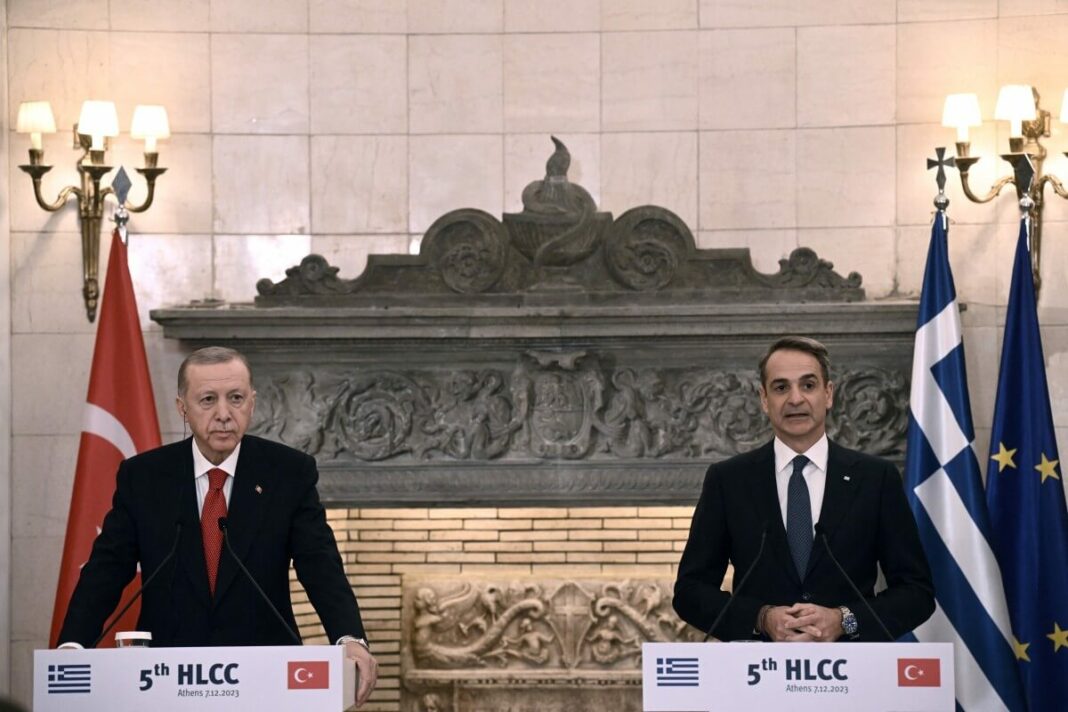
After years of tension concerning migration, energy rights and maritime borders in the Aegean Sea, Greece and Turkey restarted high-level talks in December, when President Recep Tayyip Erdoğan paid his first to Athens since 2017 and signed a declaration of friendship between the two historic rivals.
Mitsotakis reciprocated Erdoğan’s visit in May 2024.
While tensions have eased slightly following the bilateral declaration on good neighborly relations in December 2023, the marine park row reveals how fragile that detente remains.
Marine protection amid geopolitics
Greece’s initiative aligns with international conservation goals, including the pledge to protect 30 percent of national waters by 2030. Mitsotakis said the country would collaborate with local fishermen, scientists and global partners to ensure the success of the protected areas.
Athens has recently banned bottom trawling in parts of the Aegean to safeguard coral reefs, and Monday’s announcement builds on those steps.
Despite the diplomatic fallout, Greek officials say the marine parks will go forward as planned. Environmental groups have praised the initiative, but some observers warn that conservation efforts could be overshadowed by geopolitics in one of Europe’s most contested seas.