


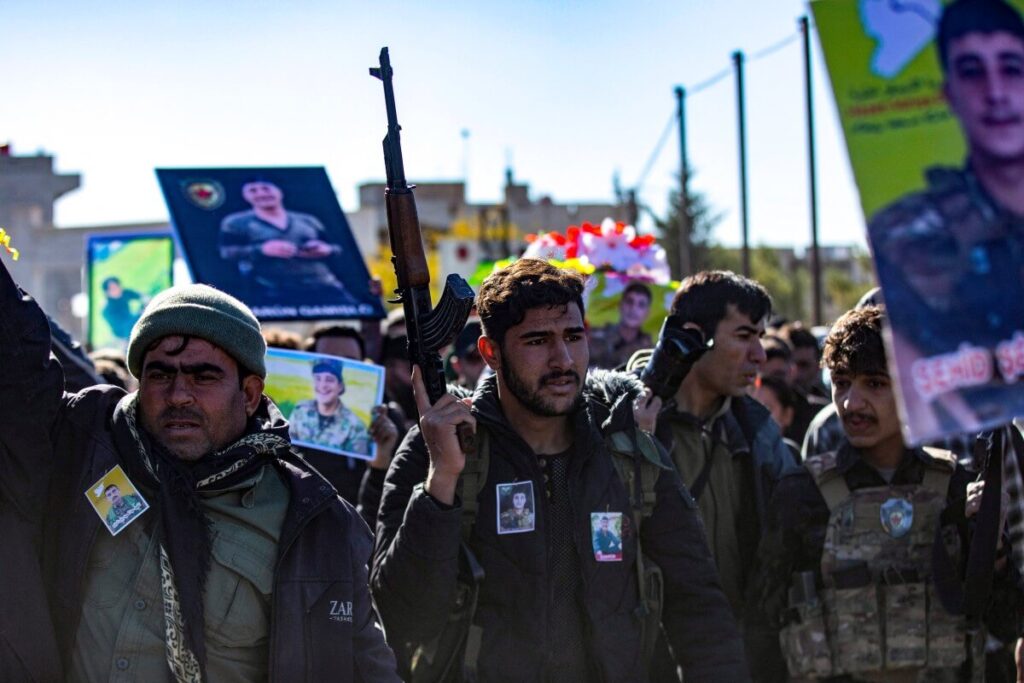
A top Syrian Kurdish official has rejected Turkish calls for the Syrian Democratic Forces (SDF) to give up their weapons as part of Ankara’s broader peace efforts with Kurdish militants, saying the situation in Syria requires integration, not the laying down of arms.
Ilham Ahmed, co-chair of the Foreign Relations Committee of the Autonomous Administration of North and East Syria, told BBC’s Turkish service that the SDF’s continued armed presence is necessary due to ongoing security threats, particularly from Islamic State in Iraq and the Levant (ISIL) remnants and the lack of a permanent Syrian constitution.
“The situation in Syria is really different,” Ahmed said. “Our fight and resistance against ISIL has its own unique nature. These groups still exist and the threat continues. Therefore, we are talking about a process of integration rather than a process of laying down arms.”
Ahmed’s remarks come amid Ankara’s efforts to expand the momentum of the outlawed Kurdistan Workers’ Party’s (PKK) July 11 move to start giving up arms to include affiliated Kurdish groups across the region. Turkish officials consider both the SDF and the People’s Protection Units (YPG) to be extensions of the PKK, which is designated as a terrorist organization by Turkey and its Western allies.
Turkish Foreign Minister Hakan Fidan renewed Ankara’s warnings following a wave of unrest in southern Syria, where a Syrian army offensive in Sweida triggered clashes with Druze militias and prompted Israeli airstrikes on central Damascus. Fidan said Turkey had received intelligence that the YPG was “on the move” and warned against exploiting the chaos.
“Any wrong steps taken during this process will pose great risks,” Fidan said late Tuesday while in New York for diplomatic meetings. “The process is delicate and fragile; everyone must take a constructive stance.”
Ahmed acknowledged the existence of a coordination channel between the Kurdish-led administration and Turkish officials, noting that discussions address regional issues, including the struggle for recognition of Turkey’s Kurds and Turkey’s presence on Syrian soil.
“We need more dialogue and coordination with Turkey,” she said. “There are also issues related to Turkey’s presence in Syrian territory. Therefore, we need more dialogue and coordination with Turkey to resolve these issues, especially security issues that concern both sides.”
Ahmed emphasized that the Kurdish administration has no intention of creating alternative military or administrative structures outside the framework of the Syrian state. Instead, she said the SDF could become a stabilizing force within a future Syrian national army, provided that power-sharing mechanisms and minority rights are guaranteed.
“Syria is still experiencing security problems,” Ahmed said. “The SDF can be a strong part of the Syrian army and play a role as a force that provides security and stability throughout Syrian territory.”
She also confirmed that talks with Damascus had not collapsed, despite reports of tension during a July 9 meeting attended by Syria’s interim president Ahmed al-Sharaa, SDF commander Mazloum Abdi and US Special Representative for Syria Tom Barrack. The talks aimed to follow up on a March 10 agreement that envisions integration of the SDF into the national army and the reintegration of Kurdish-run areas into the Syrian state structure.
“The negotiations have not collapsed,” Ahmed said. “It is normal for there to be misunderstandings and disagreements during some of the meetings. This is especially true given that Syrians have not been in dialogue with each other for years.”
She said the Kurdish leadership sees “positive signs from both sides” and supports a decentralized model of governance that would empower regions while preserving Syria’s territorial integrity.