


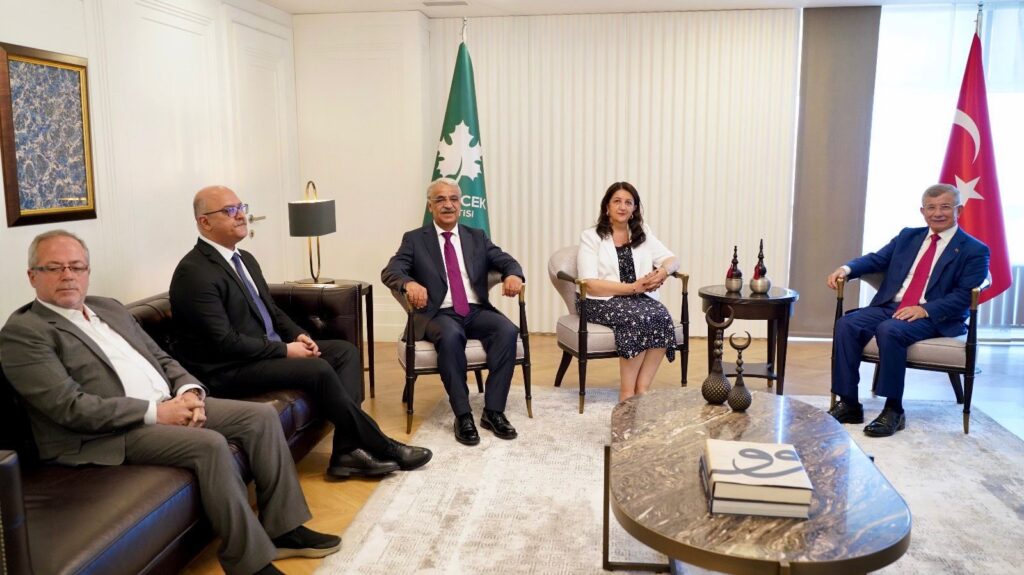
A delegation from Turkey’s main pro-Kurdish party has had a series of high-profile meetings in Ankara with political leaders to discuss ongoing efforts for peace between the government and the outlawed Kurdistan Workers’ Party’s (PKK) following a historic ceremony last week that marked the PKK’s laying down of arms.
Pro-Kurdish Peoples’ Equality and Democracy Party (DEM Party) lawmakers Pervin Buldan and Mithat Sancar, accompanied by lawyer Faik Özgür Erol, on Tuesday met with far-right Nationalist Movement Party (MHP) leader Devlet Bahçeli at his office in parliament, according to a report by the state-run Anadolu news agency. The 45-minute meeting marked a rare public interaction between the DEM Party and the MHP, known for its historically hawkish stance on the Kurdish issue.
The Kurdish issue, a term prevalent in Turkey’s public discourse, refers to the demand for equal rights by the country’s Kurdish population and their struggle for recognition.
In remarks after the meeting, Buldan described the discussion as “very positive and productive,” saying the delegation briefed Bahçeli on the latest developments in the process. “We once again heard his positive views on the process,” Buldan said, adding that they would continue talks “step by step” not only with Bahçeli but also with “leaders of other opposition parties and all components of the ruling alliance.” Buldan pledged to “keep all party leaders informed at every stage” and to continue their efforts to transform the process “into a genuine peace process as quickly as possible.”
The same delegation also visited Justice Minister Yılmaz Tunç at the ministry in the Turkish capital.
After the hour-long meeting, Buldan told reporters it was an “important and positive” discussion. “We reviewed both the political and legal dimensions of the current stage and the path forward,” she said. “We believe the justice minister will play a crucial role in the upcoming commission phase.”
The so-called commission phase refers to the expected formation of a parliamentary commission tasked with overseeing negotiations and drafting legislative proposals to institutionalize the peace process.
Sancar also described the meeting as productive, underlining the pivotal role of the Justice Ministry in ensuring the process advances on solid legal grounds. “The Ministry of Justice holds a key position in guaranteeing that this process proceeds towards peace, rule of law and democracy in a sound and healthy manner,” he said.
In addition to visits with ruling bloc figures, the DEM Party delegation also had talks with Ahmet Davutoğlu, leader of the opposition Future Party (GP), Anadolu also reported. Following the closed-door meeting at the party’s headquarters, Davutoğlu emphasized the need for national consensus to achieve a “terrorism-free Turkey” and expressed support for the peace efforts. DEM Party MPs highlighted Davutoğlu’s prior involvement in peace initiatives during his tenure as prime minister, underlining the importance of parliamentary engagement in the process.
The pro-Kurdish party is scheduled to visit main opposition Republican People’s Party (CHP) leader Özgür Özel on Thursday, continuing its effort to build cross-party engagement for the peace process.
The latest round of talks follows a series of developments that revived hopes for a peaceful resolution to the Kurdish issue. The process was reignited in October 2024, when Bahçeli, a key ally of President Recep Tayyip Erdoğan, called for Abdullah Öcalan to order the PKK to lay down its arms. Öcalan responded with a public message in February 2025, urging an end to the decades-long insurgency. The most significant milestone came last week, when a group of PKK members held a symbolic ceremony in northern Iraq, publicly destroying their weapons. This move was described by both Kurdish representatives and observers as a “first step,” with further progress tied to legal reforms and reintegration measures.
However, skepticism remains high due to the absence of concrete government action. President Erdoğan’s recent speeches, including his July 15 address in parliament, praised the shift toward a “terrorism-free Turkey” but made no mention of amnesty, political reforms or the release of political prisoners. DEM Party officials have repeatedly stressed the need for institutionalized negotiations, legislative reform and the restoration of civil rights to ensure the process yields lasting results.