


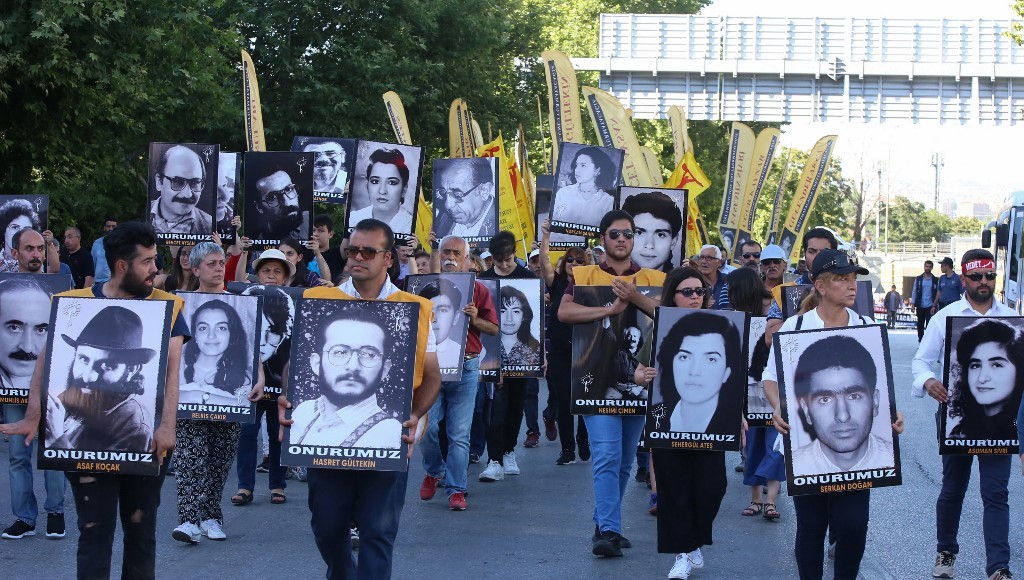
The Ministry of Justice has refused to disclose the number of people serving prison sentences due to the Sivas massacre in July 1993 on the grounds that the issue “does not concern the public,” the Stockholm Center for Freedom reported, citing the Deutsche Welle Turkish service on Thursday.
A DW reporter had sent the question to the ministry under the right to information, a provision in Turkish law that enables individuals to access government-held information.
The ministry’s General Directorate of Prisons and Detention Houses responded by claiming that the inquiry fell beyond the scope of the law as the information concerned only the institution itself.
One of the major political incidents of the 1990s, the massacre was a deadly arson that led to the death of 35 people, mostly members of the Alevi sect, who were meeting in a hotel in Sivas. The building was torched by an angry mob who gathered outside in reaction to an event held by left-wing Turkish intellectual Aziz Nesin, who was hated by religious Sunnis in Turkey as he had attempted to publish Salman Rushdie‘s controversial novel “The Satanic Verses.”
Thirty-three attendees, two hotel staff members and two protesters died in the fire. Nesin was able to escape because the attackers initially failed to recognize him.
Last month an Ankara court ruled to drop legal proceedings against three defendants who were being tried in absentia for their alleged role in the massacre, citing the expiration of the statute of limitations.
In a move that added to the controversy, President Recep Tayyip Erdoğan recently used his constitutional power to commute the sentence of 78-year-old Hayrettin Gül, who was serving an aggravated life sentence for his role in the massacre. The decision was based on medical reports citing chronic illness.
This marked the second such commutation granted by Erdoğan in connection with the massacre. In 2020, he also commuted the sentence of Ahmet Turan Kılıç, then 86, who had also received an aggravated life sentence, on similar health grounds.
While the Turkish Constitution allows the president to remit or commute sentences for reasons of chronic illness, disability, or old age, the use of this authority in such high-profile and sensitive cases has drawn public backlash. Human rights groups have called it an example of selective justice and impunity.
A number of lawyers who defended the suspects in the massacre later became politicians in Erdoğan’s ruling party.